
 Global



Student Life in Singapore: A Practical Guide for International Students
Singapore is a land of exciting possibilities! This city-state is a triple threat, boasting quality education opportunities, safety that inspires confidence, and a cultural mashup that’s anything but boring. If you plan to study in Singapore, preparation is key. Your student life in Singapore is shaped by the routines you build: where you live, how you travel, the people you meet and the support you use when you need it. For many newcomers, international student life in Singapore becomes easier once the practical details are in place. Read on for your essential guide.

What Is Life Like in Singapore for International Students?
Singapore offers a compact city environment where study spaces, food, cultural districts and weekend activities are often within reach by public transport. For those exploring international student life in Singapore, this can make it easier to build a routine beyond campus. English is widely used in daily transactions and public information, while the city’s Chinese, Malay, Indian and international communities offer many opportunities to experience different cuisines, celebrations and cultures.
Singapore is widely regarded as a safe place to study and live in. In the 2026 Global Peace Index, it ranked eighth out of 163 countries and territories and was the highest-ranked country in Southeast Asia.
In Singapore, you can start with a routine that supports your studies. Find a few convenient places to eat in, identify the route between your accommodation and campus, and leave time for rest as well as social plans. This makes the adjustment more manageable and gives you a clearer picture of student life in Singapore.
Cost of Living in Singapore for International Students
Living Expenses in Singapore: Accommodation & Everyday Spending
Singapore offers numerous budget-friendly options for accommodation, transportation, and everyday necessities. The cost of living in Singapore for international students depends largely on accommodation, food choices, transport habits and personal spending.
Accommodation is usually the largest cost item. Shared accommodation may cost less than renting a private unit, but rental arrangements and lifestyle choices vary considerably. Before committing, compare the monthly rent, utilities, deposit, contract length, commute and house rules. SIM’s guide to the cost of living in Singapore for international students outlines common accommodation options and the questions to consider when comparing them.
For a current planning benchmark, It is estimated that most international students spend about S$1,800–2,800 each month, excluding tuition fees and one-off arrival costs. You may use this range as a baseline and tailor your budget according to your housing, food, transport and personal expenditure needs.
| Planning profile | Estimated monthly cost | Approx. US$ |
|---|---|---|
| Typical monthly living costs | S$980 – 3,521 | Approx. US$1,350–2,100 |
Source: EDB
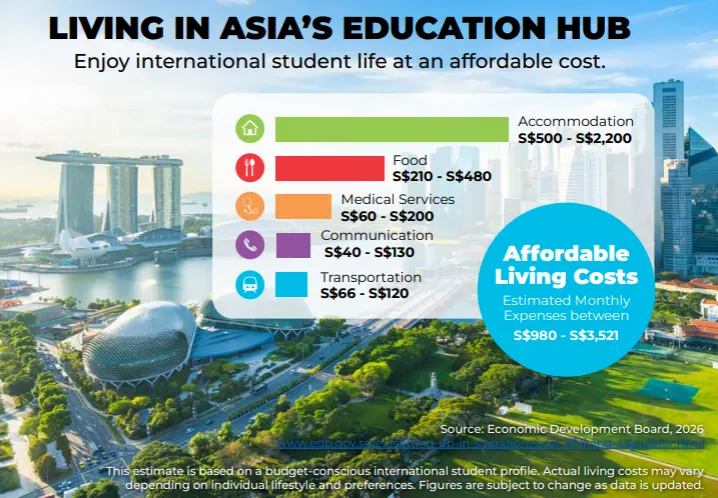
Cost of Living in Singapore: Monthly budget planning checklist
| Spending area | What to plan for |
|---|---|
| Accommodation | Rent, utilities, and wifi |
| Food and groceries | Meals, groceries, snacks and drinks |
| Transport | MRT and bus journeys, plus occasional ride-hailing |
| Study and essentials | Mobile data, course materials and basic supplies |
| Social and personal | Activities, fitness, outings and personal purchases |
Student Life in Singapore: Getting Around
Getting Around Singapore: Planning Your Daily Transport
Travel‑planning apps help you estimate arrival times and total trip duration for smoother commutes. For day-to-day student life in Singapore, the MRT and public buses make up most students’ daily travel. Since transport counts towards your regular living costs, predictable routes help you manage both your time and overall budget.
Beyond travel planning tools, you can also turn to official and institutional guidance. The Land Transport Authority provides journey-planning information and details of available concession arrangements, so check the current eligibility and fare information before you apply. SIM’s transport tips for international students can also help you plan familiar routes and use local travel tools with confidence.
Exploring Study Spaces and Everyday Places
As part of your student life in Singapore, public libraries, parks, museums and neighbourhood centres can offer conducive places to study or spend time with friends. If you plan to use National Library Board services, check the membership type, eligibility and applicable fees for foreigners before registering. Practical choices such as carrying a reusable water bottle, tracking your transport spending and planning meals for the week can make daily life feel more organised.
Campus study spaces and library facilities can also provide convenient options closer to your classes. Trying different settings for individual revision, group work and online learning can help you establish a routine that suits you.
Enjoying Food and Festivals
Food and local neighbourhoods are also part of student life in Singapore. Hawker centres, cafés and cultural districts give students simple ways to explore the city between classes. From Chinese New Year and Hari Raya to Deepavali, Singapore’s cultural calendar can offer a useful introduction to the communities that shape everyday life here.
Enjoying Events and Performing Arts
You also have access to concerts, festivals and cultural events throughout the year, enriching your student life in Singapore. Schedules change, so check official venue calendars before making plans. For a more local experience, you can explore homegrown talent at venues such as Esplanade – Theatres on the Bay, which presents traditional and contemporary performances. The National Stadium and Singapore Indoor Stadium are also popular venues for international concerts, from award-winning mandopop to Western pop and K-pop acts hailing from all over the world.
Exploring Southeast Asia from Singapore
Singapore’s prime location makes it the perfect jumping-off point for students studying in Singapore to explore Southeast Asia. As a well-connected city in Southeast Asia, it offers students opportunities to learn more about the wider region, its cultures and its diverse communities.
During academic breaks, you can choose to explore nearby destinations such as Malaysia or Indonesia, depending on your budget, travel plans, and academic schedule. With affordable flights and proximity to other countries, you can experience the rich tapestry of Southeast Asia without breaking the bank. Even without travelling, Singapore’s multicultural neighbourhoods, regional cuisine and international events provide many ways to gain broader exposure to Southeast Asia.
Student Life at SIM: Find Community Beyond the Classroom
Settling In with International Student Support
Daily routines beyond campus are only one part of student life in Singapore. Building friendships on campus can be one of the quickest ways to move from feeling new to feeling connected. SIM’s International Student Office provides onboarding and transition support for full-time international students, including practical guidance to help them settle into Singapore. It is worth using this support early, especially if you have questions about accommodation, banking, mobile services or your first weeks on campus.
If you are comparing scholarships for international students in Singapore, check the current SIM scholarships eligibility criteria before you apply. New international students enrolling in eligible SIM diploma programmes may apply for the SIM GE Academic Excellence Scholarship or SIM GE Merit Scholarship. Current undergraduate students, including international students, may apply for the SIM STARRR Award or Sports & Artistic Talent Award.
Joining Student-Centred Activities
SIM GE offers a range of co-curricular activities across arts and culture, international student communities, student councils, special interests, and sports and fitness. These activities offer ways to meet people and enrich your student life in Singapore.
Joining clubs or student activities is an easy way to meet classmates from different programmes. At SIM Global Education, 80 clubs, sports teams and cultural groups allow students to explore interests outside lessons. You do not need to step into a leadership role right away. Simply attending events or joining beginner sessions is a great start. Consistent participation counts more than formal positions, and these gatherings offer a relaxed atmosphere to settle into campus life.
Making Use of Career Support
As you settle into student life in Singapore, you can also begin thinking about your next steps. Career support can be most useful when you start before you urgently need to apply for a role. When you are ready, you can use SIM GE’s Career Connect for career guidance, skills workshops, employer talks, networking sessions and career events. CareerSense brings career resources, internships and job opportunities together in one digital platform.
Career fairs and employer activities can be a useful way to learn what organisations are looking for, explore available opportunities and practise talking about your interests. Dates, formats and available opportunities can change, so check CareerSense and current student communications before making plans.
You do not require a fully finalised career plan to utilise these services. You can begin with simple, actionable steps: look through roles that spark your interest, join a workshop, or consult a career adviser to address any questions you have.
Workshops and online resources will help you polish application documents and articulate your experience confidently. Employer talks and industry events also offer valuable insights into the demands of various professions and sectors. As your interests take shape, leverage these events and networking chances to connect with professionals outside your academic circle.
International Student Life in Singapore: First-Month Checklist
- Confirm your accommodation, tenancy terms and route to campus.
- Build a monthly budget and review it after your first few weeks.
- Complete any required campus onboarding and save key support contacts.
- Join one activity or event that interests you.
- Give yourself time to adjust; a comfortable routine usually develops step by step.
Student life in Singapore can be as active or as calm as you make it. With a practical plan, reliable support and an openness to meeting people, you can create a university experience that extends well beyond the classroom. Explore SIM Global Education’s undergraduate programmes to learn more about the study pathways available.